El principio de eliminar marcas de agua de imágenes: algoritmos de IA frente a métodos tradicionales
Tabla de contenidos
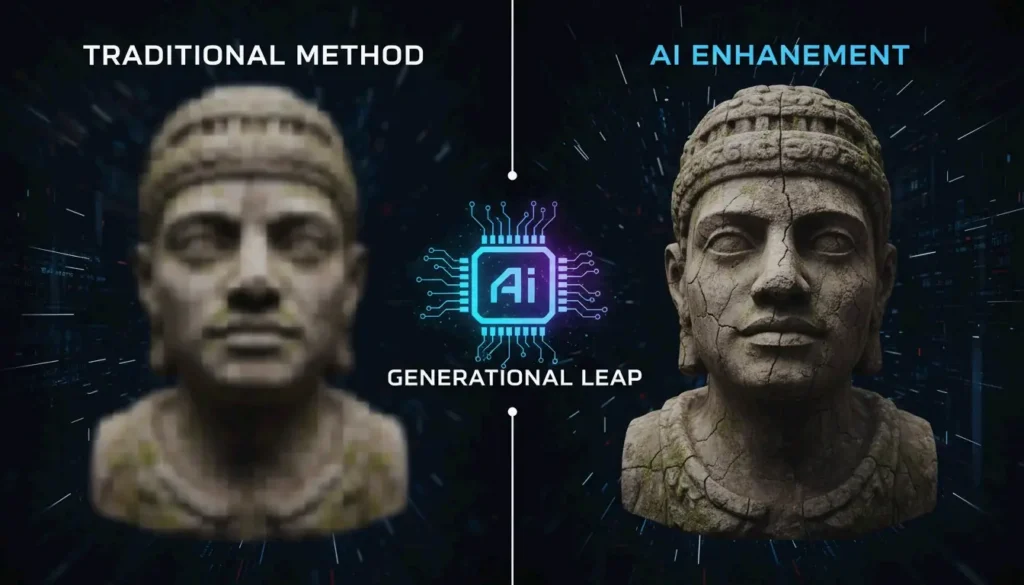
A fecha de mayo de 2026, el principio de eliminación de marcas de agua en imágenes ha pasado del clonado manual a algoritmos de IA como el generative inpainting (relleno generativo). Mientras los métodos tradicionales dependen de la réplica manual de píxeles, la IA moderna predice los datos ausentes mediante GANs y Diffusion Models para reconstruir texturas de forma natural. Esta evolución ofrece una calidad 8K superior y ahorra a los profesionales más de 4.5 horas semanales.
Principios básicos: cómo los algoritmos de IA frente a los métodos tradicionales eliminan marcas de agua
La verdadera diferencia entre los algoritmos de IA y los métodos tradicionales radica en cómo rellenan los huecos. La lógica tradicional trata la marca de agua como una imperfección física que debe cubrirse o como una capa matemática que debe invertirse. La IA, en cambio, ve la zona con marca de agua como una “laguna contextual”. Observa el resto de la imagen para imaginar qué debería estar ahí, en lugar de limitarse a intentar borrar algo.
Según un TechTrends Report, los profesionales que usan herramientas nativas de IA ahorran unas 4.5 horas semanales en comparación con quienes siguen atascados en el clonado manual fotograma a fotograma.
Lógica tradicional: resolver la ecuación de Alpha Compositing
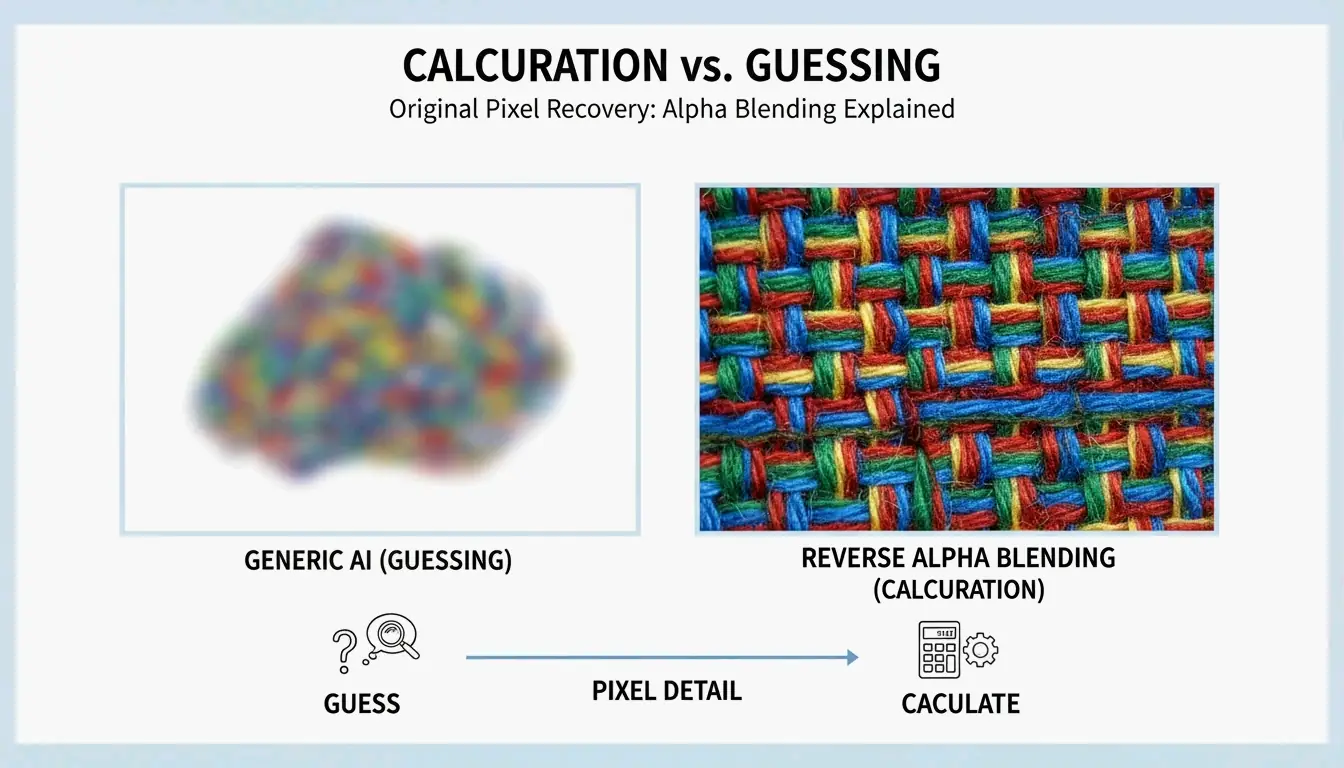
Las herramientas tradicionales suelen recurrir a Reverse Alpha Blending (mezcla alfa inversa) para recuperar los píxeles originales. Considéralo un problema matemático. El software asume que la imagen sigue una fórmula concreta: $Watermarked = \alpha \cdot Logo + (1 – \alpha) \cdot Original$. Si la herramienta logra deducir la transparencia ($\alpha$) y los colores del logotipo, puede calcular cuáles eran los píxeles “Originales”.
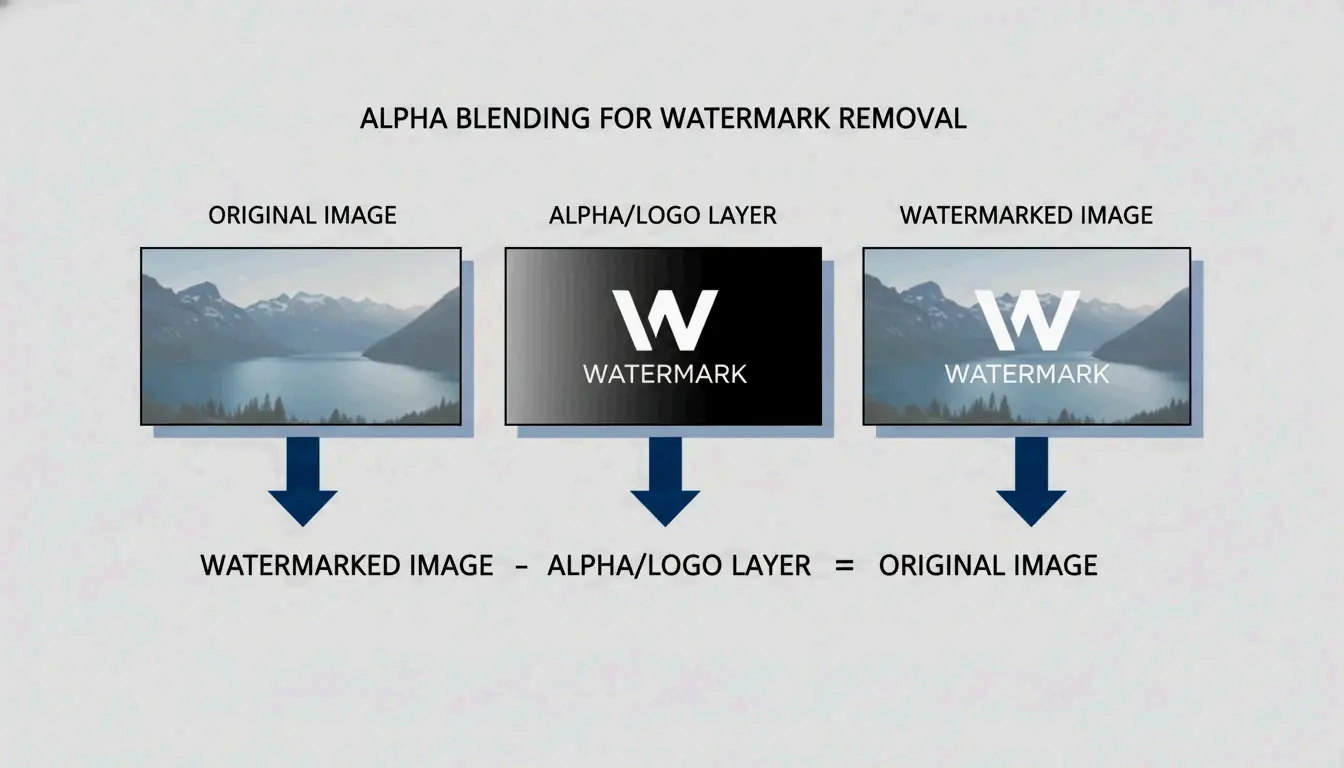
Como se observa en el proyecto Gemini Watermark Remover, esto funciona bien con logotipos semitransparentes cuyas propiedades son conocidas. Pero si los cálculos fallan por poco, queda una “imagen fantasma” o una mancha borrosa. Otras tácticas clásicas incluyen el “Cloning” (clonado), es decir, copiar y pegar sellos de píxeles de un punto a otro, o simplemente “Cropping” (recortar) los bordes de la foto para eliminar la marca de agua por completo.
Lógica de IA: consciencia contextual mediante aprendizaje profundo
La eliminación basada en IA emplea AI Inpainting (relleno o inpainting de IA) para construir píxeles totalmente nuevos. En vez de limitarse a mover datos existentes, los modelos de IA estudian patrones, iluminación y texturas para “alucinar” un fondo realista. Herramientas como Pixelbin aprovechan estos modelos de aprendizaje profundo para detectar y eliminar marcas de forma automática, sin que tengas que hacerlo a mano.
Para 2026, esta tecnología se ha trasladado a la computación en el borde (edge computing) y a conexiones en la nube de alta velocidad. Esto permite que redes neuronales complejas limpien contenido de alta resolución casi al instante. A diferencia de un simple desenfoque, el AI Inpainting conserva el grano y el detalle originales de la toma, haciendo que la reparación sea casi imposible de detectar.
Análisis técnico en profundidad: Generative Adversarial Networks (GANs) y Diffusion Models
En 2026, la batalla tecnológica entre los creadores de marcas de agua y las herramientas de eliminación se libra con dos grandes arquitecturas de IA: GANs y Diffusion Models.
GANs y arquitecturas de discriminador
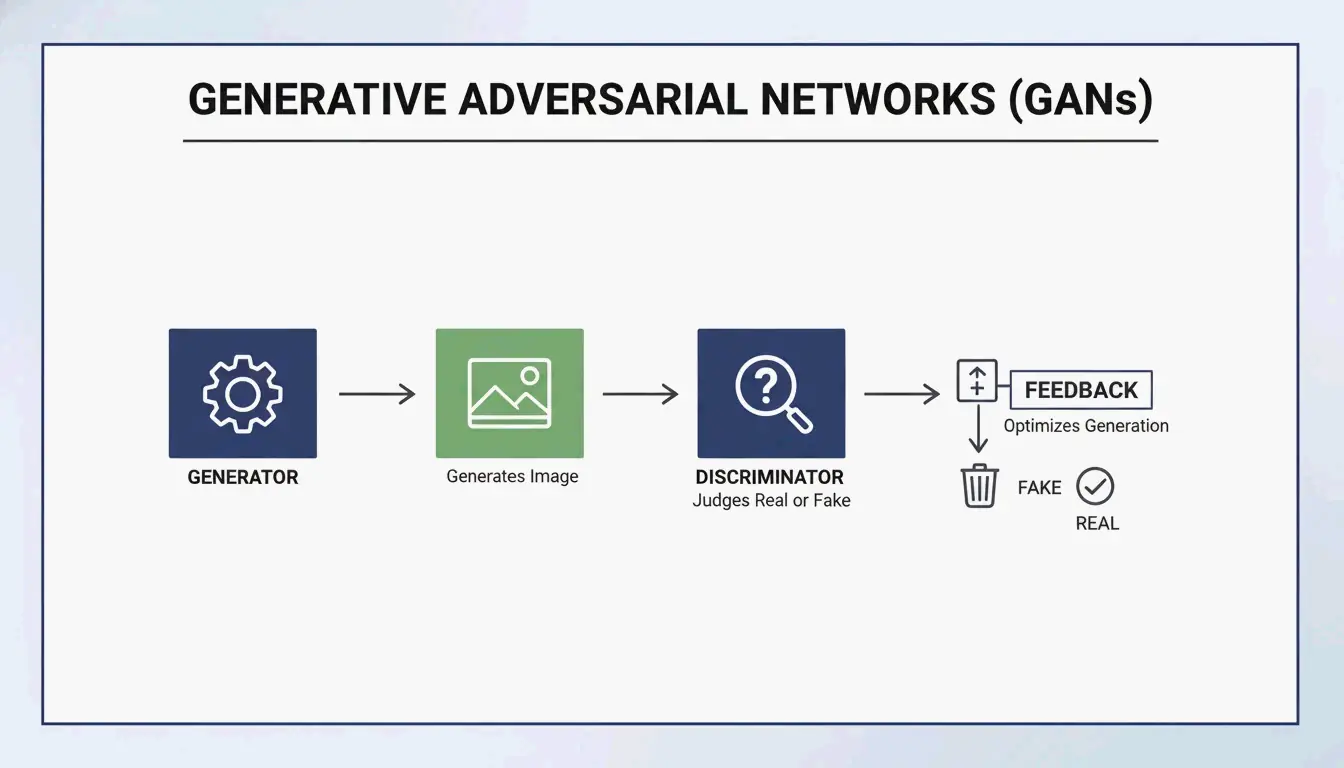
Generative Adversarial Networks (GANs, redes generativas antagónicas) funcionan como una competición entre dos modelos de IA. Uno (el encoder, o codificador) intenta reconstruir el fondo que falta, mientras que el otro (el discriminator, o discriminador) intenta cazar el error comparándolo con una imagen real. Esta “pugna” entre ambos obliga a la IA a crear texturas increíblemente realistas. Como señala Side-Line, los GANs son un pilar de las configuraciones modernas tipo “encoder-decoder”, ayudando a ocultar o eliminar identificadores con un impacto mínimo en el aspecto de la imagen.
Diffusion Models: el estándar de oro de 2026
Los Diffusion Models son hoy la opción preferida para la reconstrucción de alta calidad. Funcionan “denoising” (eliminando el ruido) de una imagen. Dado que una marca de agua es, en esencia, un patrón estructurado que no pertenece a una imagen “natural”, el modelo la trata como ruido y la elimina.
La investigación de NeurIPS Researchers muestra que incluso las marcas de agua invisibles pueden eliminarse con estos modelos sin arruinar la calidad de imagen. Para comprobar los resultados, los expertos consultan las métricas PSNR y SSIM. Una restauración de IA de primer nivel, como las que usan el ROBIN Framework, puede alcanzar un SSIM score de 0.98. A ese nivel, la salida es básicamente idéntica al archivo original sin marca de agua.
¿La eliminación es realmente sin pérdidas? Comprender el Reverse Alpha Blending
A los equipos de marketing les encanta la palabra “lossless” (sin pérdidas), pero la realidad es algo más matizada.
Reverse Alpha Blending es matemáticamente sin pérdidas, pero solo si se dispone de la máscara y de los valores alfa exactos. Los métodos más antiguos basados en Discrete Cosine Transform (DCT, transformada de coseno discreta) suelen fallar cuando una imagen se comprime. Como las marcas DCT siguen reglas matemáticas fijas, son objetivos fáciles para los ataques de eliminación que conocen exactamente cómo funcionan esas reglas.
La “alucinación” de la IA no es técnicamente sin pérdidas, porque crea píxeles nuevos en lugar de recuperar los antiguos. Sin embargo, en el panorama de 2026 —donde el 85% de los estudios de vídeo profesionales usan relleno generativo según el Global Digital Media Institute— los resultados se consideran “perceptualmente sin pérdidas”. Gracias a la velocidad 6G, ahora podemos procesar contenido 8K sin los antiestéticos artefactos de compresión que antes arruinaban estas ediciones.
La carrera armamentística de 2026: C2PA Standard y falsificación de marcas de agua
A medida que las herramientas de eliminación mejoran, la industria contraataca con nuevos estándares, aunque también han aparecido nuevos riesgos como WMCopier.
- WMCopier y Forgery (falsificación) : La investigación de Zhejiang University (2025) destacó WMCopier, una herramienta capaz de “extraer” una marca de agua de una imagen y “pegarla” en otra. Esto facilita falsificar la autoría, haciendo que el contenido ilícito parezca provenir de una fuente legítima.
- C2PA Standard (estándar C2PA) : Para frenarlo, se creó el C2PA Standard. Empareja las marcas de agua con metadatos firmados criptográficamente. Aunque una IA elimine el logotipo visible, una firma a nivel de hardware permanece en los datos del archivo para demostrar su origen.
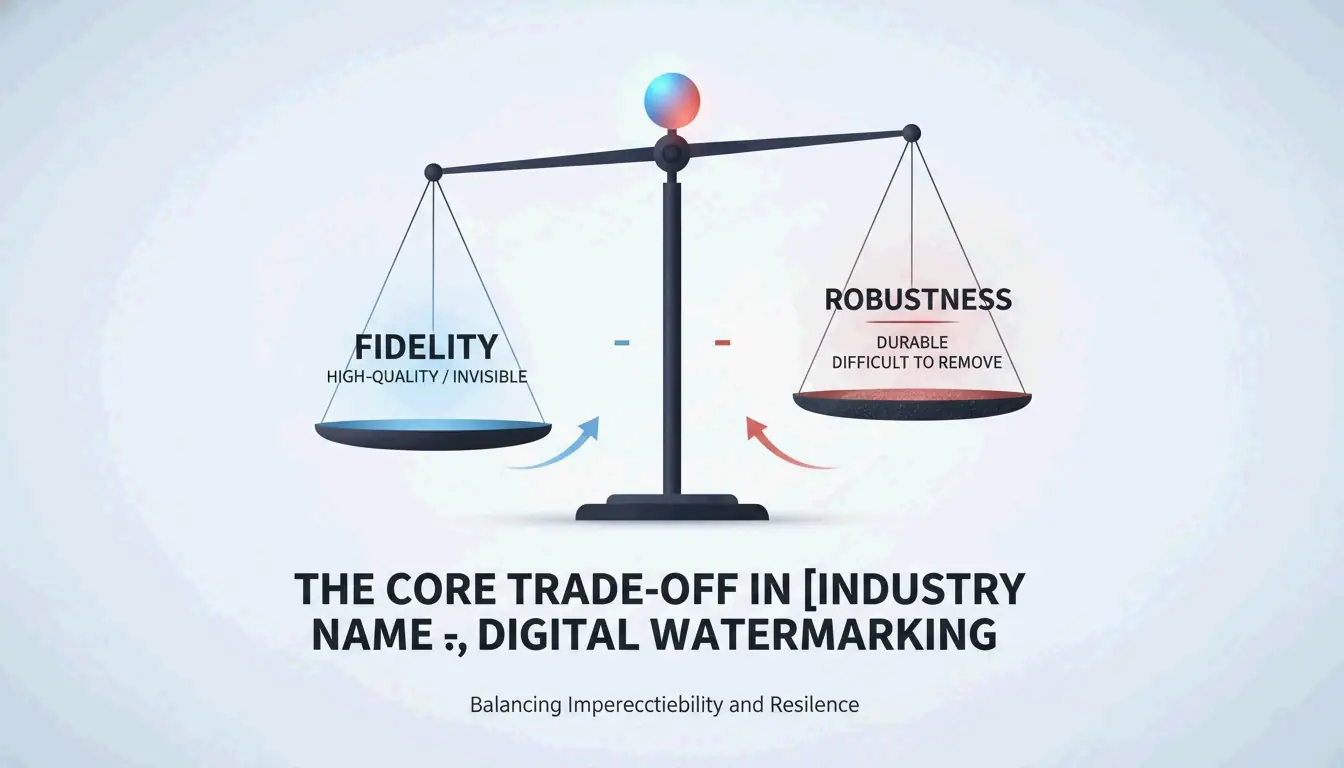
- Fidelity-Robustness Trade-off (compromiso fidelidad-robustez) : Este es el gran desafío. Si haces una marca de agua demasiado fuerte (robustness o robustez), empieza a verse fea (baja fidelity o fidelidad). Defensas modernas como Adversarial Robustness Testing (ROBIN) ahora entrenan específicamente las marcas de agua para sobrevivir a los “regeneration attacks” (ataques de regeneración) empleados por los Diffusion Models.
Conclusión
La eliminación de marcas de agua ha recorrido un largo camino desde el simple copiado de píxeles hasta la reconstrucción neuronal avanzada. Aunque los métodos matemáticos como Reverse Alpha Blending aún tienen su lugar para superposiciones sencillas, el AI Generative Inpainting es la única opción real para los contenidos complejos y de alta resolución de 2026. Nos encontramos en una era de “Fidelity-Robustness Trade-off”, donde el objetivo es que los marcadores sean invisibles para el ojo humano pero obvios para el software forense. Para los profesionales, herramientas como Pixelbin son esenciales por su rapidez, pero conviene siempre cotejar los resultados con los C2PA standards para mantener la ética y demostrar que tu contenido es auténtico.
Preguntas frecuentes
¿Eliminar una marca de agua con IA afecta a la resolución final de la imagen?
Los algoritmos de IA modernos de 2026 mantienen la resolución nativa de la imagen. Mediante el escalado por super-resolution (superresolución) y el inpainting contextual, herramientas como Pixelbin rellenan el hueco de la marca de agua sin alterar las dimensiones en píxeles. A diferencia del recorte tradicional, que reduce el encuadre, la reconstrucción por IA garantiza que la salida final siga siendo de alta definición o 8K.
¿Puede la IA eliminar marcas de agua forenses invisibles como SynthID?
Aunque la IA puede eliminar con facilidad las capas visibles, los marcadores forenses como SynthID de Google están profundamente incrustados en la distribución de píxeles. Los “regeneration attacks” basados en Diffusion pueden atenuar estas señales, pero a menudo resulta difícil eliminarlas por completo sin degradar la calidad de imagen. Además, los metadatos compatibles con C2PA aportan una capa de protección secundaria que persiste incluso si los píxeles visibles se alteran.
¿Qué es el compromiso fidelidad-robustez en las marcas de agua digitales?
El compromiso fidelidad-robustez es el equilibrio entre hacer que una marca de agua sea invisible para el ojo humano (fidelity o fidelidad) y difícil de eliminar (robustness o robustez). La IA ha roto ese equilibrio; las marcas tradicionales de tipo frequency-domain (dominio frecuencial) son ahora detectadas y eliminadas con facilidad por las redes neuronales, lo que obliga a los desarrolladores a emplear entrenamiento adversarial para ocultar las marcas de agua en regiones que los modelos de IA tienen menos probabilidades de modificar.
Sobre el autor
Indie Hacker & DesarrolladorSoy un indie hacker que construye aplicaciónes iOS y web, enfocado en crear productos SaaS practicos. Me especializo en AI SEO, explorando constantemente como las tecnologias inteligentes pueden impulsar el crecimiento sostenible y la eficiencia.
Última revisión 2 de julio de 2026. Este artículo se revisa para garantizar su precisión y se actualiza cuando cambian las herramientas o el comportamiento de la plataforma.
Política editorial
Cómo ImageLean investiga, prueba y actualiza las guías publicadas.
Divulgación de publicidad
Cómo gestionamos la publicidad, los patrocinios y la monetización en el sitio.
Enfoque de privacidad
Por qué nuestras herramientas priorizan la privacidad y cómo funciona el procesamiento basado en el navegador.